The project
An open implementation of the 5G RAN CU/DU stack.
OCUDU is an open, modular implementation of the 5G RAN CU/DU stack, designed to bring carrier-grade performance to open networks. Built with a focus on flexibility, hardware abstraction, and real-time execution, OCUDU enables developers and operators to deploy, extend, and experiment with next-generation RAN architectures from software-defined PHY pipelines to accelerator-backed deployments.
It serves as a foundation for building scalable, interoperable, and future-ready wireless systems across both research and production environments.
Our vision
OCUDU India - an integrated open telecom ecosystem.
At OCUDU India, our goal is to go beyond a standalone RAN stack and build a fully integrated open telecom ecosystem.
We actively work toward bringing together key open-source and emerging technologies across the stack:
- Core networks
- Magma Core · Aether SD-Core · Free5GC
- RAN & orchestration
- O-RAN Software Community · SMO · ONAP
- Intelligence & automation
- AI-RAN · Digital Twin Networks
- Security
- Post-Quantum Cryptography (PQC)
- Infrastructure & interfaces
- Open M-Plane · RISC-V
By integrating these components into a cohesive environment, we aim to enable:


Real-world deployments

Rapid experimentation across layers
The focus is simple: interoperability, performance, and openness across the entire telecom stack.
Get started
Clone and build.
Stand up a local checkout and build the reference stack in two commands.
ocudu-india build
$
Latest release
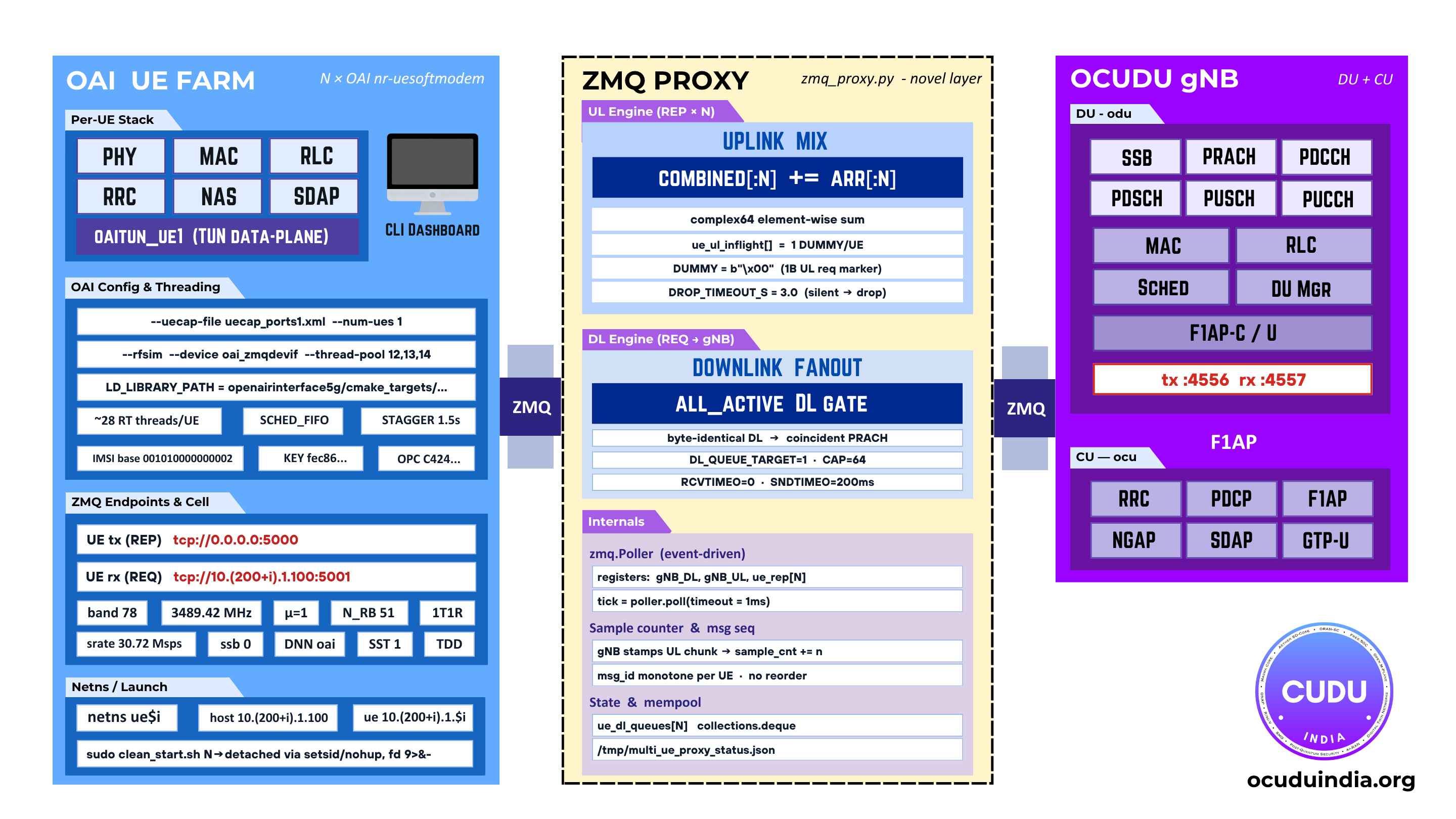
Scaling OCUDU RAN Testing: From Single UE to Multi-UE Simulation
OCUDU India extends OAI's new ZMQ-capable nr-uesoftmodem into a multi-UE testbed: N OAI UEs against a single OCUDU gNB, joined by a Python IQ-superposition proxy, per-UE Linux network namespaces, wave admission into the 5G CN, and a live Rust/ratatui dashboard.
Read the post